The People, Streets, and Memories Connected by Photography

Dreaming of a Life in Photography

Shinjuku Station Southeast Exit Plaza 1984⇔2020
Despite its prime location in front of the station, this was once a special place known as Gotaiten Plaza, home to a monument commemorating Emperor Showa’s enthronement in 1928 (Showa 3). The unusual terrain was one reason redevelopment was slow to progress. The present plaza was completed in 1994, and the monument was relocated to Juniso Kumano Shrine in Nishi-Shinjuku. In March 2020, just before a state of emergency was declared, two Takato Kohigan cherry trees were in full bloom here. They were a gift from Ina in Nagano Prefecture, a friendship city of Shinjuku Ward.
I began borrowing my father’s camera around junior high school, photographing school events and other occasions. I enjoyed making prints for the girls at school and seeing how pleased they were to receive them. Even then, I saw a camera as a way of connecting with people.
By high school, photography had become a real passion. A friend and I would often visit the galleries in Ginza. One day, at a secondhand camera shop in Ginza 1-chome, we happened to meet the photographer Jun Miki. When I later went to give him the photographs I had taken that day, he told me, “If you want to make a career in photography, you should go to university first and study.” His advice set me on that path, although I cannot say I enjoyed studying for the entrance exams.
After two years of preparing to retake those exams, I went to a book signing by Nobuyoshi Araki at Kinokuniya Bookstore in Shinjuku. I was 20, and it was the summer holiday. Afterward, Araki took me to a café. He seemed rather amused that someone so young had come along.
Listening to him, I still had little idea what being a photographer involved, but it sounded like an enjoyable life. I asked him which Japanese photographer he admired. “Who else but Daido Moriyama?” he replied. Without hesitation, I enrolled at the photography school where Moriyama taught.
A Commercial Career Begins in Magazines


Nichigeki Theater, Yurakucho 1981⇔2020
The Nippon Gekijo, affectionately known as Nichigeki, awaits demolition in 1981. Having survived wartime air raids and escaped requisition by the postwar occupation forces, the theater had been a symbol of Japan’s entertainment industry for nearly half a century. It was later demolished along with the neighboring Asahi Shimbun Tokyo headquarters, and the Yurakucho Center Building, commonly known as Yurakucho Mullion, was built on the site. Today, the complex houses Hankyu Men’s Tokyo, Lumine, Marunouchi Piccadilly, and other businesses.
Moriyama and Masahisa Fukase were teaching at the school then, while Araki and Shomei Tomatsu would also join us for summer camps and exhibitions. Looking back, it was an extraordinary privilege. Yet seeing these photographers at close quarters made me realize how difficult it would be to live entirely as an artist. I could not imagine leading a life quite as intense as theirs.
After graduating, I associated working as a photographer with working for magazines, so I went to a bookshop to find one I would be thrilled to see my photographs in. The magazine I chose was Heibon Punch. I called the publisher, and the person who happened to answer was the deputy editor.
I took along my street photographs of Tokyo and pictures from my travels in Europe. He found them interesting and introduced me to a young editor. The photographs from my first assignment were given a generous two-page spread. Other editors soon began getting in touch, and the work grew from portraits of entertainers to corporate editorial assignments and, eventually, advertising. I was fortunate to work on a remarkable variety of projects.
Two Years Photographing the Streets of Tokyo


Naka-Shibuya Railway Underpass 1984⇔2024
In a Shibuya that never stops changing, the Naka-Shibuya railway underpass still retained traces of the past when this photograph was taken. In 1984, it was a quiet backstreet with few pedestrians, leading to Miyashita Park and Nonbei Yokocho. Even after the opening of MIYASHITA PARK, something of the old atmosphere lingered beneath the tracks. Note: The photograph was taken in May 2024, before the murals were created.
When I told Moriyama I was starting to work for magazines, he said, “Run an independent gallery for two years, and keep making your own work.” So a group of us set up Gallery Sakuragumi.
My turn to exhibit came around every three months, and that was how I began photographing the streets of Tokyo. I would take pictures between assignments or in the neighborhoods I visited for work, on my way there and back.
My photographs were the opposite of Moriyama’s in style. I looked at the streets with an even gaze, making images with gradations all the way from white to black. I was drawn to photographs that observed the city from a little distance, such as Lee Friedlander’s work, which Fukase had introduced me to, and Araki’s series Tokyo wa Aki (Tokyo in Autumn). At first, my work received no recognition at all. Gradually, though, even Moriyama began to tell me he found it interesting.
At the time, high-rise buildings were going up one after another in Shinjuku, and the streets were becoming tidier. That made the old buildings that looked likely to be demolished all the more appealing to me. I wanted to photograph them as a record before they disappeared. In Shibuya, where our gallery was, I was photographing Hyakkendana and the area around the Dotonbori Theater, rather than Parco or Seibu.
Rediscovering Forty-Year-Old Photographs During the Pandemic


Naganoya Shokudo, Shinjuku Station Southeast Exit 1984⇔2021
At the foot of the stairs stands Naganoya, a long-established restaurant founded in 1915 (Taisho 4). It is a rare place where time seems to have stood still in the Showa era. In July 2021, with a state of emergency in effect, there were few people on the streets of Shinjuku. The quiet made its former bustle seem almost unimaginable.
I turned 60 in 2020. With time on my hands during the pandemic, I began sorting through the photographs at my office. That was when I came across the pictures of Tokyo I had taken around 1984.
I had never moved offices, which was one reason I had kept the negatives rather than throwing them away. They were in good condition, filling four or five boxes, each about the size of a clothes storage container.
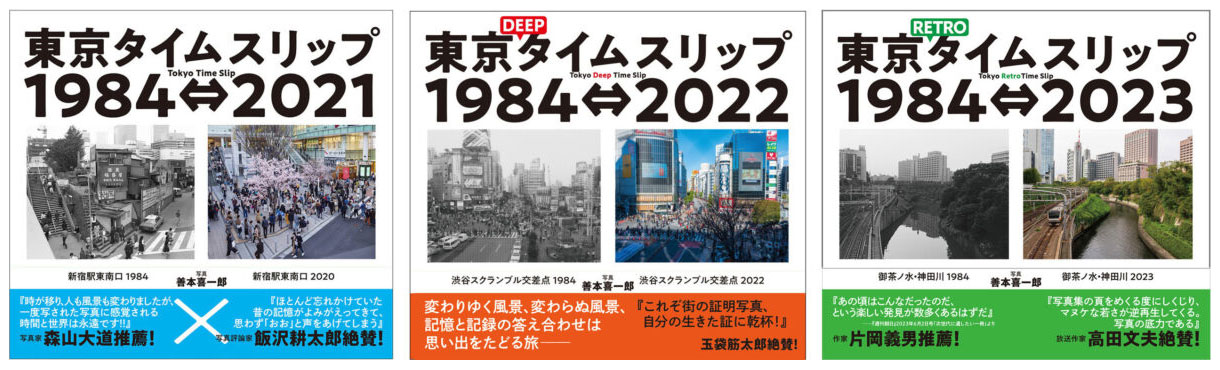
Simply showing the old photographs on their own did not seem very interesting, so I revisited the places I had photographed and posted the old and new images together on Instagram. Friends who worked as editors and designers took an interest. Within just three months or so, a deal was in place to publish my photobook, Tokyo Time Slip 1984⇔2021.
The people passing through those old photographs are fascinating, too. There are no smartphones, people are smoking as they walk, and the fashions have such style. The buildings and cars have distinctive designs as well. People often leave comments saying they prefer how things used to look. Lately, though, I have also become interested in what has stayed the same. Ueno Station, for example, has changed surprisingly little.
As my following has grown, people who run the shops in the photographs, or who know the places I have pictured, have left comments. Sometimes those comments become the beginning of an ongoing connection.
I also photographed a new story, “SHIBUYA: THEN AND NOW,” for A Magazine Curated By Hiroshi Fujiwara, published in France. Using my 1984 photographs of Shibuya as a starting point, I brought past and present views of the streets together, photographing models at seven locations in present-day Shibuya and elsewhere. That, too, came about through Instagram.
There has been considerable interest from people overseas, and I would like to keep building on that.
Finding My Way to OM SYSTEM


“Shinjuku Tiger,” Shinjuku Station East Exit 1984⇔2022
The person in the 1984 photograph was indeed “Shinjuku Tiger.” Across a span of 38 years, photography brought a memory together with the person who had been there.
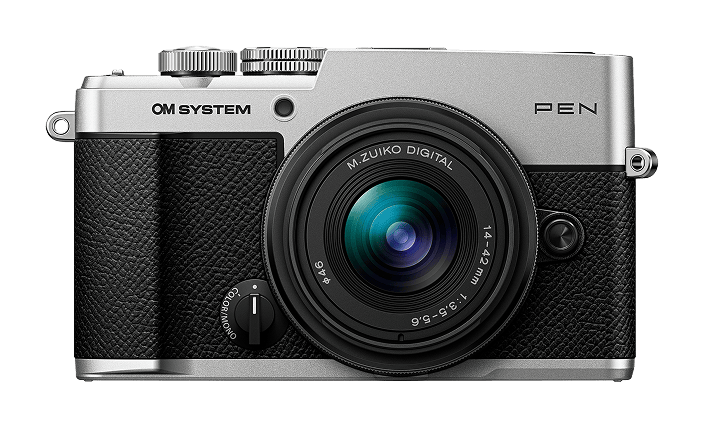
For the present-day images in my Tokyo Time Slip series, I use cameras such as the PEN-F and OM-D E-M1 Mark II, paired with the M.ZUIKO DIGITAL 17mm F1.8 prime lens.
My connection with OM SYSTEM goes back to the days of Olympus—and it began with a printer.
Around 2000, I was taking on more portrait work in my office studio, photographing business owners, medical professionals, and others, and delivering the results as prints. Color matching with inkjet printers was quite a challenge in those days, so I was looking for a better printer. Someone recommended the Olympus CAMEDIA P-400, a dye-sublimation thermal-transfer printer, and I began using it.
It reproduced skin beautifully, with smooth tones and lovely color. I liked it so much that I bought the same model again three times. Later, I began using the E-300 digital SLR, which also worked well with the printer in terms of color reproduction. The color management was excellent.
I have continued using Olympus and OM SYSTEM cameras ever since. Much of my work is on location, so I appreciate the dust reduction system that helps remove dust from the sensor, along with the dustproof and splashproof construction that lets me photograph outdoors with confidence. Their compact size suits me, too.
A Once-in-a-Century Opportunity I Cannot Miss


Freshman Bakery, Shibuya 1984⇔2023
Freshman Bakery opened on Dogenzaka Koji in 1949 (Showa 24), closing in 1997 (Heisei 9) after 48 years. In 2023, the building next door was still standing.
It has been 40 years since I began working as a commercial photographer. Had Moriyama not told me to run an independent gallery, I doubt I would have made personal work at all.
Shortly before Tokyo Time Slip 1984⇔2021 was published, I let him know. Along with the message “A late-blooming debut,” he sent me these words of endorsement: “Time has passed, and both people and landscapes have changed. Yet the time and the world we sense in a photograph, once captured, are eternal!!” I used those words on the band wrapped around the book.
Receiving those words made me feel that everything had finally led to this point.
Perhaps, in some small way, I had been able to give something back to him.
Those 40 years span my own life in photography, but for someone working in a company, they might represent an entire career, from starting work to retirement. Some people seem to see their own lives reflected in these photographs. Discovering how differently people respond to them has been a revelation. To me, that is part of what makes photography so interesting.
A camera has brought me into contact with people I would never otherwise have met, and taken me to places I would never otherwise have gone. But these days, I have no desire to go anywhere else. Tokyo is changing every day. We are living through what people call a once-in-a-century transformation, and I would hate to miss the chance to photograph it. That is how I feel now.
Photography by Kiichiro Yoshimoto
Written by Nahoko Ando
English translation by the OM SYSTEM team
Profile
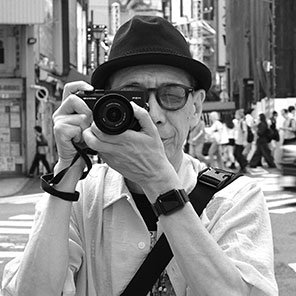
Kiichiro Yoshimoto
JAPAN
Born in 1960, Kiichiro Yoshimoto has been photographing the streets of Tokyo since the 1980s. His Tokyo Time Slip series pairs photographs from the past with present-day views of the same places, photographed from the same vantage point. His work explores urban change and people’s memories. He is Vice President of the Japan Advertising Photographers’ Association (APA), a public interest incorporated association. In 2021, Kawade Shobo Shinsha published Tokyo Time Slip 1984⇔2021. He has since published Tokyo DEEP Time Slip 1984⇔2022 and Tokyo RETRO Time Slip 1984⇔2023, and continues to photograph Tokyo today.